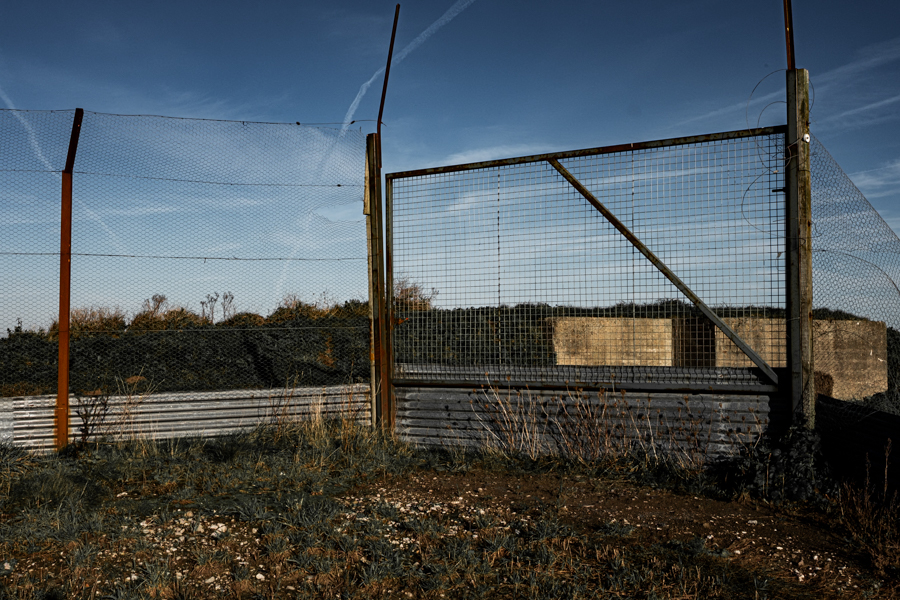
This chapter positions the fenced enclosure as a critical motif within the wider narrative of the Plague Ship Project.It represents a physical manifestation of what Judith Butler describes as“differential grievability” the idea that certain movements,lives and bodies become regulated through spatial practices that determine their legitimacy.The fence becomes an index of societal attempts to stabilise perceived threats by controlling proximity.
The structure operates on multiple symbolic registers. Historically,it resonates with the quarantining logic of plague-era maritime governance:danger is kept offshore,containment is enacted through distance and the border becomes the technology through which fear is spatially organised.The fence literalises this logic,making visible the impulse to divide landscape into zones of safety and risk.
Economically,the enclosure invokes Sekula’s critique of the maritime supply chain.The free circulation of goods contrasts sharply with the heavily mediated movement of migrants,whose journeys are framed through surveillance and risk.The fence becomes a terrestrial mirror of the maritime border—a reminder that while ships move freely,those fleeing conflict or instability encounter barriers at every crossing.
Ecologically and geographically,the image captures a landscape in which natural openness is repeatedly interrupted by man-made thresholds.These interruptions form what John Wylie calls “topologies of tension”— spaces where landscape becomes a negotiation between memory,fear and political intervention.
Within the project’s broader visual sequencing,this image serves as a hinge between mythic past and critical present.It demonstrates how the coastal environment continues to absorb and reproduce the same anxieties that once animated the legend of the Plague Ship.The coastline remains a site where arrival is conditional,where movement is questioned and where the politics of belonging are enacted in quiet,everyday structures.