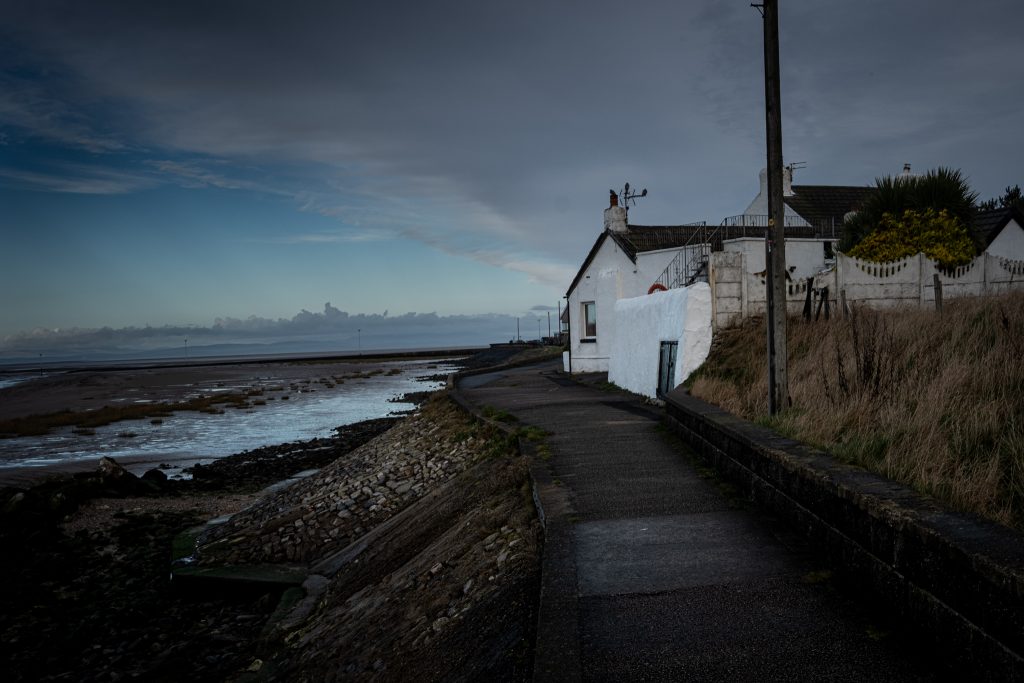
This image positions Knott End as a critical secondary landscape within the broader project,not as a confirmed site of plague quarantine,but as a geography shaped by the same governing principles.Estuaries historically served as zones of suspension, spaces where arrival could be delayed,monitored and regulated without immediate engagement.The photograph foregrounds this condition through its emphasis on elevation,separation and controlled access.
The chapter situates the estuary within a lineage of maritime governance that extends from early modern public-health practices to contemporary border enforcement.The plague ship narrative provides a historical framework in which danger is imagined as external,arriving from the sea and requiring spatial containment.This framework reappears in modern migration discourse,where boats carrying people are framed as threats rather than humanitarian concerns.
Drawing together Sekula’s critique of maritime capitalism and Sebald’s conception of landscape as a silent archive,the image reveals how coastal infrastructures materialise fear.The seawall,path and domestic boundary do not merely protect against erosion;they symbolise an enduring desire to regulate proximity. In this sense,Knott End operates not as an anecdotal addition to the project,but as a reinforcing site — one that demonstrates how quarantine logic,once established,becomes embedded in place and continues to shape how societies imagine safety,belonging, and arrival.