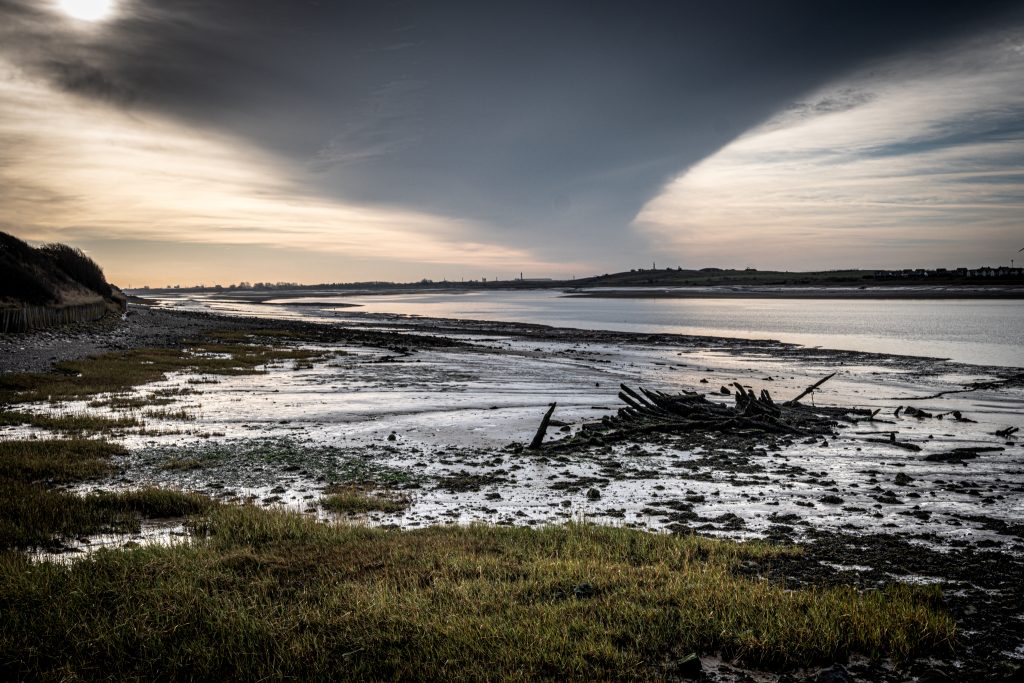
This image positions the estuary as a space of enforced distance.The horizon is not simply a visual endpoint but a psychological one,a line where movement is monitored,delayed,or refused.Historically,this stretch of coast functioned as a place where vessels suspected of carrying disease were held offshore, neither permitted entry nor entirely expelled.The act of waiting became a form of control.
The estuary’s wide,exposed geometry reinforces this condition. Water recedes,mudflats expand and access is suspended by tidal rhythm rather than by walls.The landscape itself performs quarantine.It does not need signage or authority;the vastness and uncertainty of the terrain hold bodies,vessels and intentions in a state of suspension.
In the present moment,this logic remains intact.The horizon continues to operate as a zone of fear and projection.Small boats crossing water are read not as acts of survival but as threats approaching from beyond the visible line.The distance once associated with contagion is now associated with social, political and economic anxiety.What has changed is not the fear itself,but the language used to justify it.
This image resists spectacle.There is no drama in the foreground,no human presence demanding attention.Instead,the photograph asks the viewer to confront how absence functions. The empty water recalls those kept waiting beyond it, historically and now while the calm surface masks the violence embedded in exclusion.
To hold the horizon,then,is to maintain a boundary without building one.It is a quieter form of defence,rooted in delay, distance, and denial.The estuary becomes not just a site of passage,but a mechanism through which societies rehearse their fear of arrival.What remains unresolved is how long this horizon can continue to bear that weight.