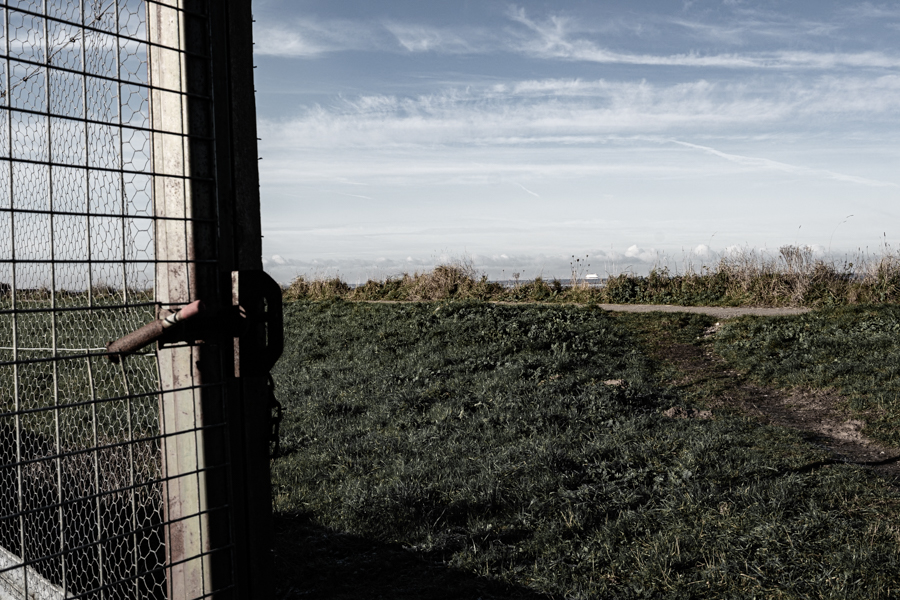
This chapter positions the gate as a structural and conceptual device through which the photograph articulates maritime anxieties across multiple historical periods.The gate is not merely a physical object but a symbolic expression of controlled access — a visual reminder of how societies historically manage fear through boundary-making.
In the context of the Plague Ship legend,boundaries operated as forms of protection against unseen and poorly understood threats.Offshore quarantine practices and the psychological separation of“here”and“there”defined communal responses to epidemic danger.Such practices resonate with contemporary border regimes,where fear is projected outward,onto bodies approaching from elsewhere.
The distant vessel in the image forms the second axis of meaning,connecting the scene to global maritime capitalism.The ship functions as an emblem of the logistical systems discussed by Sekula,where goods are abstracted into flows,unburdened by the complexities that constrain human mobility.This creates a conceptual tension: goods can move freely across oceans,while people are increasingly immobilised by deterrence policies and national border infrastructures.
The gate,positioned between the viewer and the landscape, becomes the third layer of interpretation.It signals the threshold at which these narratives meet.Drawing on thinkers such as Giorgio Agamben,the gate can be understood as a device through which sovereign power is enacted determining who may pass,who must wait and who is excluded.The photograph thus becomes a meditation on the politics of visibility and access: the ship is clearly seen yet distant,the gate is near yet limiting.
By integrating myth,economic structure and contemporary migration,the image reveals how landscapes become repositories for collective fear and contested belonging.The coastline is not a neutral space;it is an active participant in shaping the stories societies tell about safety, danger and the other.