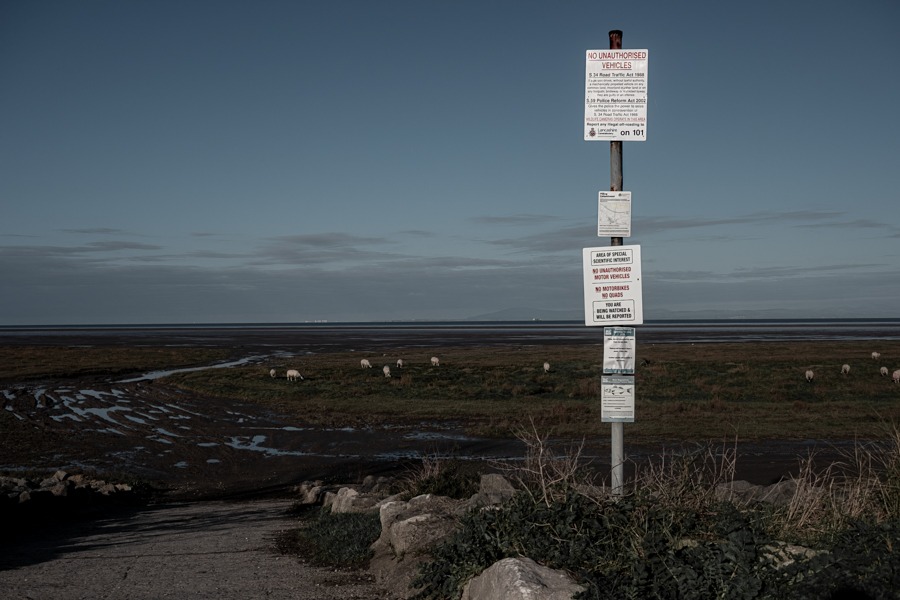
The signpost emerges in this chapter as a critical marker of the intersection between land-based governance and maritime uncertainty. Positioned at the threshold between the built environment and the tidal marsh,it articulates the regulatory impulse that defines coastal edges.The Pilling shoreline, historically associated with fears of disease and contamination through the Plague Ship legend,continues to be framed and interpreted through mechanisms of control.
The pastoral presence of grazing sheep in the middle ground introduces a visual counter-narrative:one of domesticity, continuity and rural labour.However,this tranquility does not undo the signpost’s instructions;rather,it heightens the sense that fear and restriction often coexist with the everyday.The horizon line serves here as both visual boundary and conceptual threshold,marking the space where global maritime trade,local myth and modern humanitarian crisis converge.
In the context of migration and maritime governance,the signpost may be read as a symbolic locus for contemporary anxieties.While the cargo ship, as Sekula argues, is emblematic of the invisible labour circuits of capitalism, the migrant boat is hyper-visible,burdened with narratives of crisis and intrusion.The signpost—fixed,rigid,and textual—contrasts sharply with the fluid and uncertain movements at sea.Its presence in the image foregrounds the politics of boundary-making that have long shaped this coastline and continue to do so in the present.