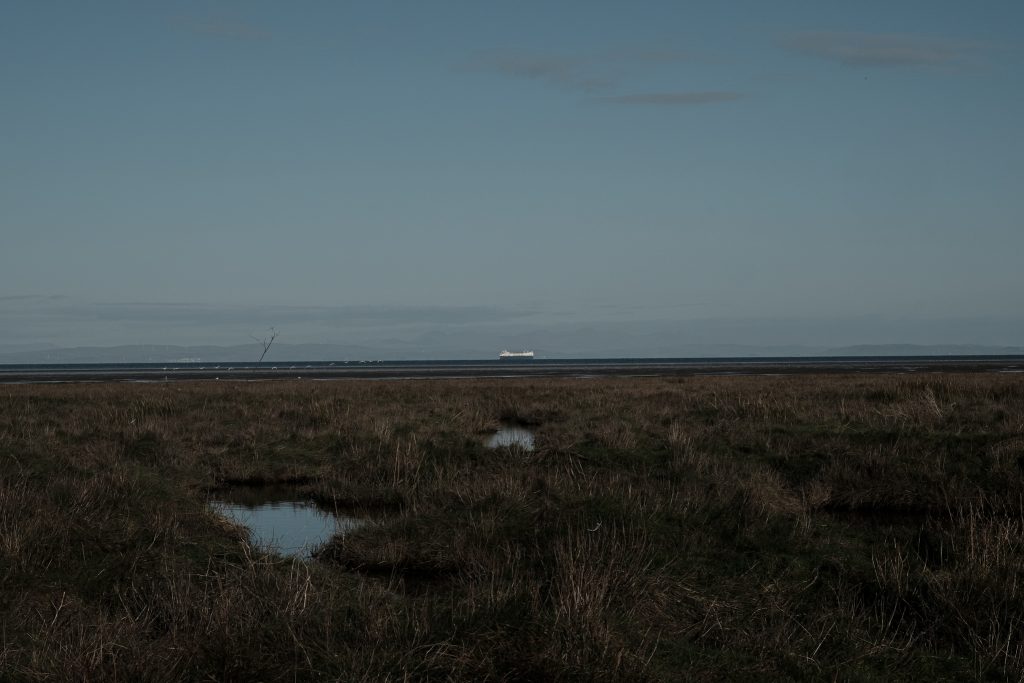
In this Chapter,this photograph brings the project’s key themes into a single,cohesive frame.At first glance we see a quiet stretch of marshland giving way to an expansive estuary,but the real point of friction sits on the horizon—the faint white silhouette of a cargo vessel, brightly lit against the muted coastal palette.That small detail changes the entire spatial logic of the image.The ship becomes both a contemporary object and a historical echo,a visual hinge connecting the local myth of the Plague Ship with modern anxieties around offshore vessels,waiting boats, and the politics of permission and refusal at national borders.
The landscape itself appears drained of drama:subdued colours,flat light,a gentle fall-off across the marsh.Yet this stillness is charged.It feels like a site where something has happened or might happen again.The photograph uses that atmospheric quiet to raise questions about distance—how far away danger needs to be before a community feels safe,what it means when something is close enough to see but not close enough to reach.Historically,this was the exact emotional territory in which the Plague Ship myth emerged:fear held at a distance,danger suspended offshore, and a landscape that served as a buffer zone between the “safe” community and the unknown.
The contemporary resonance is unavoidable.That small shining ship now draws the viewer into conversations about migration routes, maritime exclusion, and the contradictions of global capitalism,in which goods move freely across oceans while people cannot.The ship becomes a symbol of mobility and restriction simultaneously—echoing the way this coastline once served as a psychological frontier between disease and safety,insiders and outsiders.
Formally,the image holds all of this together through restraint.The darkened marsh foreground creates a weighted base,a heaviness that mirrors the emotional tone of the project.The middle distance—flat,quiet,emptied—acts as a temporal void,a place where history feels suspended.And the bright ship on the horizon becomes a visual and conceptual interruption:a fragment of the present intruding on a landscape shaped by its past.This single frame therefore encapsulates the project’s central argument:that landscapes are not neutral spaces but living archives,storing myth, fear,memory and contemporary politics simultaneously.