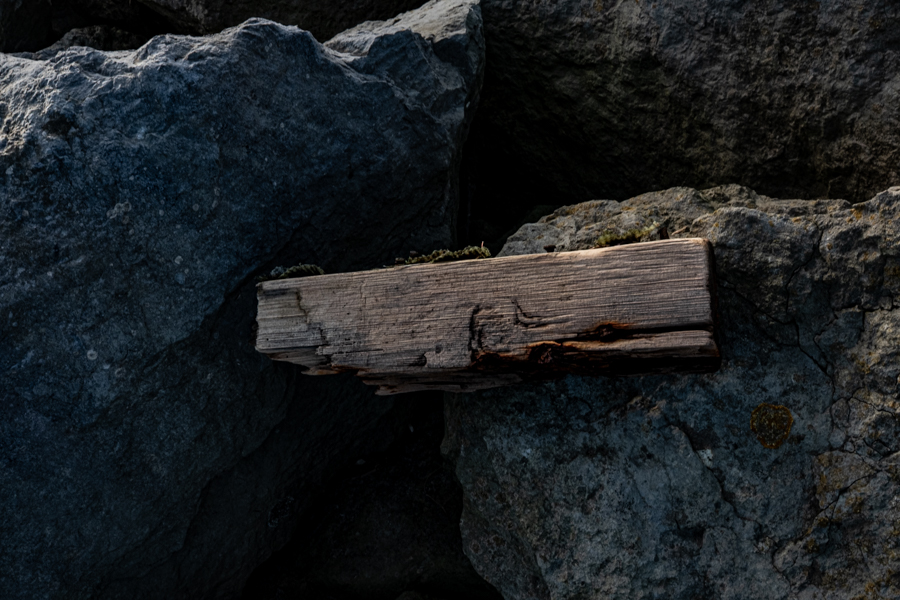
This chapter focuses on the photograph of a weathered timber fragment lodged between coastal rocks,interpreting it as a symbolic object through which the project’s larger themes of fear, movement, and maritime identity can be articulated.The timber’s ambiguous origin invites speculation:it may be a remnant of local sea defences,part of a fishing craft,or detritus borne from distant industrial activity.What matters is its status as a displaced fragment a material residue that has crossed boundaries and come to rest on this particular coastline.
The coastline at Pilling is itself a site of layered narrative density.It is a geography shaped by tidal flux,erosion and the slow accumulation of human and nonhuman traces.As such,the timber functions as a “narrative object,” a focal point through which broader stories become accessible.The photograph offers a microcosmic view of the project’s conceptual terrain:a landscape that archives the past not through monuments but through fragments.
Historically,the Plague Ship myth situates danger at sea.Communities externalised fear by imagining illness lingering offshore.When viewed within this narrative,the timber becomes a symbolic relic a piece of an imagined vessel left behind, echoing the logic of quarantine and exclusion.The wood’s deterioration mirrors the erosion of the myth itself,now embedded into the rocks of local memory.
Within the industrial narrative,the object connects to the global maritime economy.As explored through Allan Sekula’s Fish Story,the sea is a vast logistical stage upon which goods circulate invisibly.Objects like this timber,dislodged and displaced,are the accidental by-products of such circulation.They reveal the unseen labour,the scale of movement and the environmental consequences of maritime capitalism.
In humanitarian terms,the timber evokes the fragility of migrant vessels — boats often improvised,overloaded or abandoned under duress.These vessels carry people instead of goods,yet their material traces frequently go unrecorded.The fragment becomes a mute testimony to structures that have failed or been left behind,symbolising the precariousness of human movement across hostile waters.
The photograph juxtaposes the organic texture of the wood with the immovable solidity of the stone.This material contrast functions metaphorically:wood is the material of mobility, of boats,of borders crossed;rock is the material of immobility,of borders enforced.The tension between them articulates the politics of movement central to both historical quarantine practices and contemporary migration.
This image therefore positions the fragment of timber as a relational object — one that mediates between myth and modernity,between local lore and global systems,between individual vulnerability and structural forces.Through this material analysis,the photograph becomes not just an image but a conceptual anchor for understanding how the coastline continues to negotiate its role as a site of arrival,exclusion and memory.