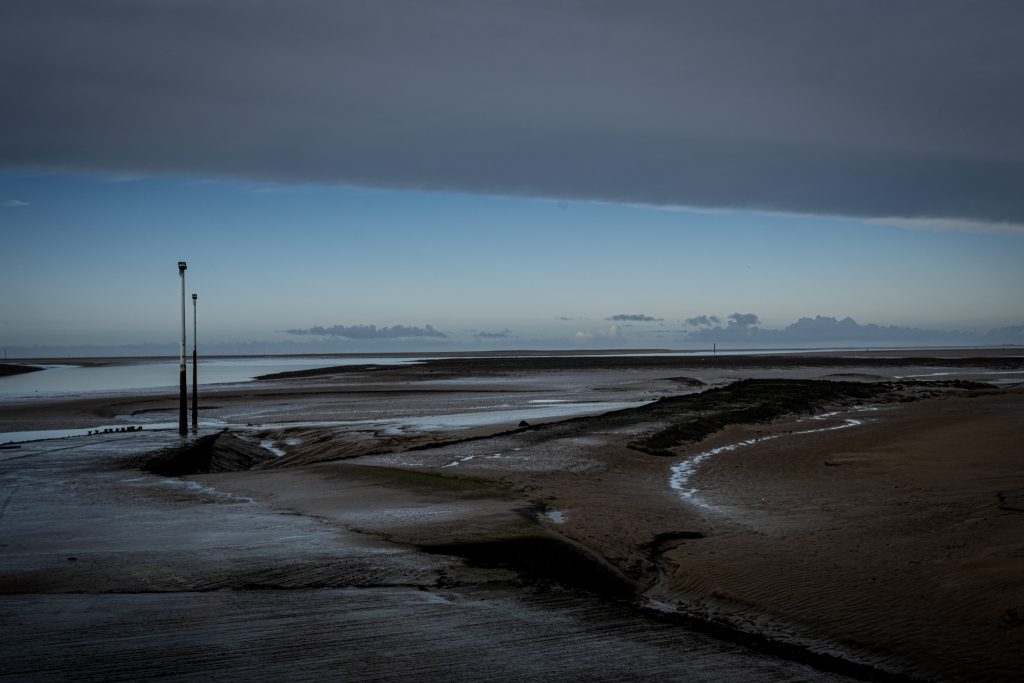
This chapter reads the slipway at Knott End as a material trace of how coastal landscapes organise and restrict movement.Unlike open shorelines,the slipway formalises access to the sea, embedding authority into the landscape through design and orientation.In this image,the slipway does not deliver passage but exposes distance,reinforcing the estuary as a space of waiting rather than arrival.This condition resonates strongly with early modern quarantine practices,particularly the logic of the Plague Ship,in which vessels were deliberately held offshore to spatially manage fear and contagion.The photograph positions the slipway as a contemporary echo of that logic:a structure that promises connection while enforcing separation.By situating the slipway within a wide,emptied estuarine landscape,the image reveals how the coastline continues to function as a regulatory zone,one where histories of disease control,maritime trade and modern anxieties around migration converge.The landscape becomes not a backdrop,but an active participant in the ongoing negotiation of who is allowed to land and under what conditions.