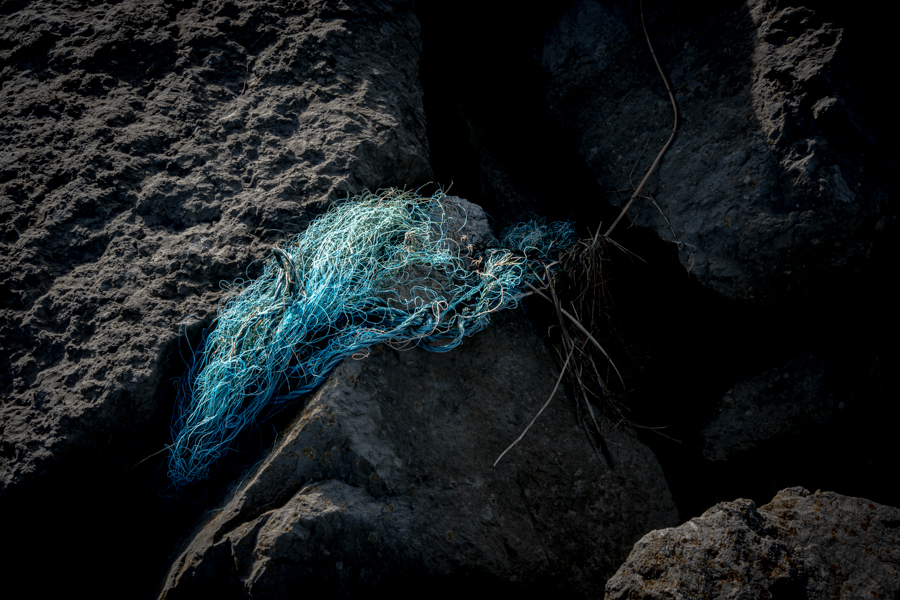
In this chapter,the image of the tangled blue fishing net lodged between the dark,uneven rocks operates as a critical visual hinge within the project,drawing together historical anxieties surrounding plague ships and the ongoing realities of modern migrant crossings.At first glance,the net appears as a mundane piece of coastal debris a leftover artefact from commercial fishing or tidal movement.Yet its material and symbolic properties resonate far beyond its immediate context.The disorderly weave of synthetic fibres echoes the experience of entanglement that has defined maritime mobility across centuries:the sense of being caught,immobilised or held in place by forces outside one’s control.Historically,plague ships embodied this condition.Their passengers were simultaneously in transit and in confinement, physically afloat yet politically and socially trapped by fears of contamination and state-imposed quarantine protocols.The net,in its fragile yet constricting form,mirrors that tension between movement and restriction.
In the contemporary moment,this metaphor of entanglement has become newly urgent.The image invites a reading that connects the net’s chaotic form to the precarious vessels used by migrants attempting dangerous sea crossings,where safety is uncertain and the possibility of detention,interception or shipwreck shapes every journey.The net becomes a stand-in for the systems legal,political and environmental that ensnare those seeking refuge or opportunity.Just as the plague ship marked bodies as threats requiring containment,today’s migrant boats are framed within narratives of risk, suspicion and crisis.This shared language of danger and contamination transforms the sea from a space of passage into a site of surveillance and exclusion.
The placement of the net within the rocks strengthens this interpretation.The rocks feel heavy,ancient and unyielding,contrasting sharply with the delicate loops of blue fibre.This visual juxtaposition reflects the broader imbalance between vulnerable human movement and the rigid structures of border governance.The net’s position neither fully integrated into the landscape nor free from it suggests a state of suspension,as though caught mid-transit and denied resolution. The coastal setting reinforces this reading,functioning as a liminal zone where journeys begin,end,or are abruptly halted.Historically,shores have served as thresholds of inspection,judgement and control:places where incoming ships were monitored for disease and where contemporary migrants encounter the realities of border enforcement.
Importantly,the net also carries a ghostly quality.Its unnatural colour and tangled form evoke something washed ashore from a traumatic event,like a fragment of a vessel that failed to complete its crossing.This spectral presence links the photograph to the memory of maritime disaster from historical plague outbreaks to modern shipwrecks that have become part of the Mediterranean and Channel’s political landscape.In this sense,the net is not merely an object but a witness:a residue of crises that recur across time,reminding us that the sea continues to be a stage for human vulnerability and institutional power.
By situating such an unassuming object within this broader historical and political framework,the photograph demonstrates how the material environment of the shoreline holds layered,often overlooked narratives.The net serves as a subtle but potent interlocutor between past and present,exposing the continuity of maritime anxieties and the enduring role of the sea as both a pathway and a barrier.In doing so,the image extends the project’s central argument:that contemporary coastlines are palimpsests where old fears of contagion and new fears of migration intersect,shaping how societies imagine and attempt to regulate the movement of bodies across water.